
Growing the Field
What is the 2025 Nobel Prize in Economics about?

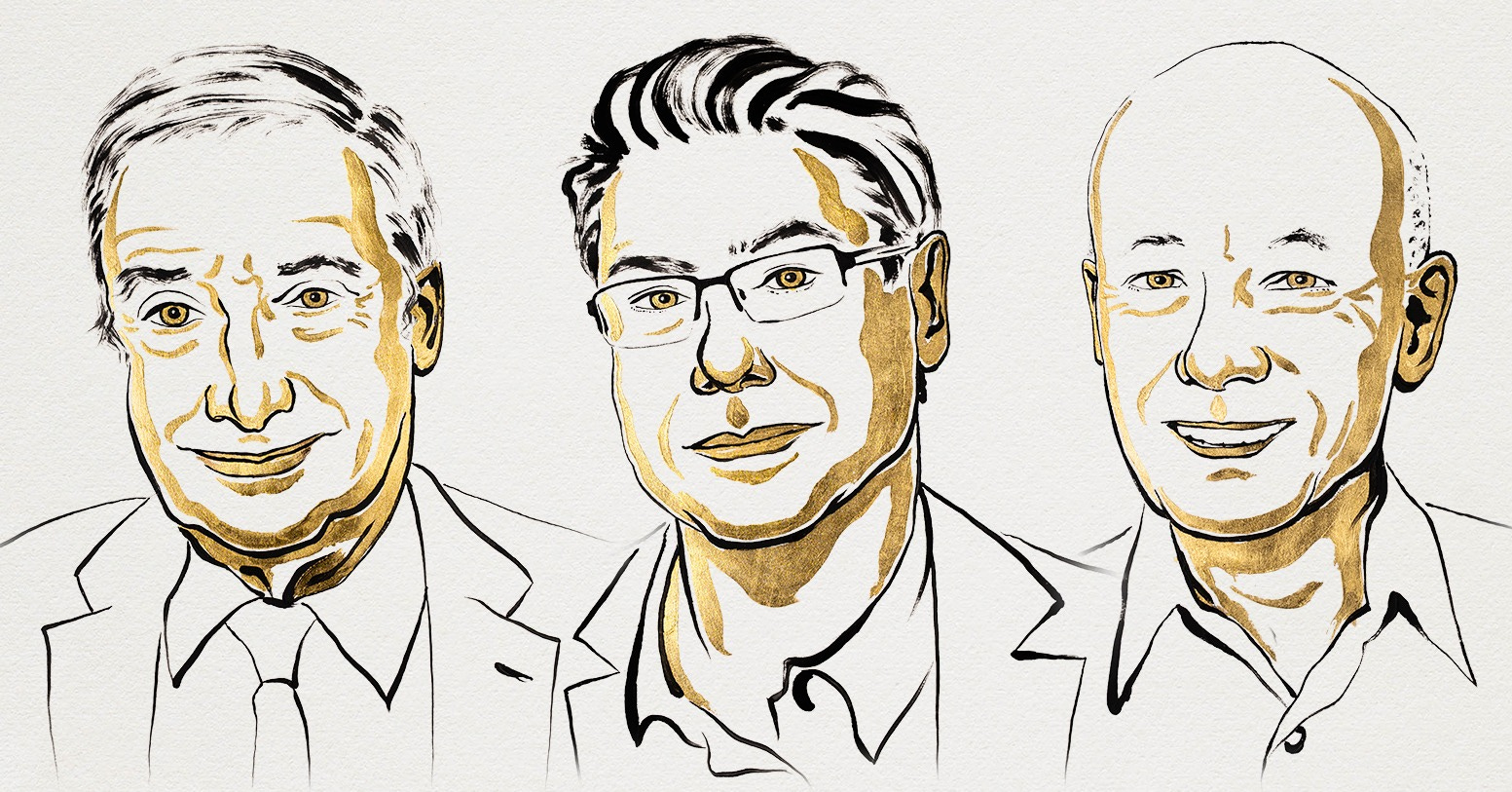
Joel Mokyr, Philippe Aghion, and Peter Howitt won the Nobel Prize in Economics today for their contributions to the field of economic growth, particularly relating to technology. All three of them have been in some sort of shortlist for a while, particularly Aghion and Howitt, whose model has become part of the textbook canon. So what is the whole thing about?
The two schumpeters (like trumpeters get it? get it?)
The first, and much better known, half of the Nobel Prize went to Aghion and Howitt. The two of them put forward a very famous model of growth that puts technology, and not really investment in physical or human capital, at the center.
For this, we need a little bit of history. The oldest textbook model used to explain per capita economic growth is the Solow Growth Model, named after its creator, Robert Solow (who won a Nobel Prize). Without going into too much detail, the model is centered around population growth, technology, and savings being constant across time and around production depending only on labor and capital (workers and machines, so to speak) - thus, growth depends on stable characteristics of a population, things like the percentage of income that is saved, how quickly capital needs to be replaced (depreciation), and the rate at which technology grows. These factors are obviously not exclusively economic, but depend on a variety of factors: institutions, government policies, etc. Solow’s work wasn’t just theoretical, but also empirical, finding that the vast majority of growth came not from investment and population growth, but from technology, what he called “the residual” and what’s commonly understood as Total Factor Productivity.
But then the big question was where technology comes from, because it seems to be the big one and it’s kind of not explained at all - especially because some of the key predictions, like income convergence between rich and poor countries, didn’t seem to be happening at all, and rich countries just stayed richer. A different Nobel Laureate, Paul Romer, came up with the next big innovation: endogenous growth theory, called thusly because technology was endogenous to the rest of the model. Romer’s big insight was tha ideas (designs or blueprints for doing something or making something) can be shared between people, because they’re not exhaustible or “rival”.This means that, as much as it’s technologically feasible, any number of people to use an idea simultaneously once it has been invented. This means that economies have increasing returns to scale: the more people and ideas a country has, the more new ideas it can come up with, so that growth is self sustaining in some ways. Because companies can use the computer or the steam engine once it’s already been invented, then the same idea can be used in new businesses over and over again, so if you double the physical inputs and the quality or quantity of the ideas, then you will more than double total production because you can combine any number of ideas on how to use things together.
Endogenous growth theory was good, but it didn’t really explain some things. For starters, why technology was unevenly adopted over time, and across countries, and why technological progress seemed to ebb and flow in the decades since the 1970s rather than continue smoothly. This was because growth, to Romer, was something of a black box, a pile of ideas that grew steadily - but, in reality, the process was anything but smooth, particularly because new innovations often destroy the value of old ones. For example, internal combustion destroyed the steam engine for vehicles, and the computer wiped out a lot of technical jobs and know-how. The idea, known as creative destruction, was coined by Austrian (country, not school) economist Joseph Schumpeter, and it explains why capitalism is evolutionary and iterative - technology matters across time, so that a company can dominate the future of the market, and not across firms. In Schumpeter’s vision, the goal was to become a natural monopoly, to build the most efficient or prestigious business - but only for a while. All monopolies are ephemeral in a world of growing innovation: every Microsoft eventually becomes an IBM, and every Ford a Kodak.
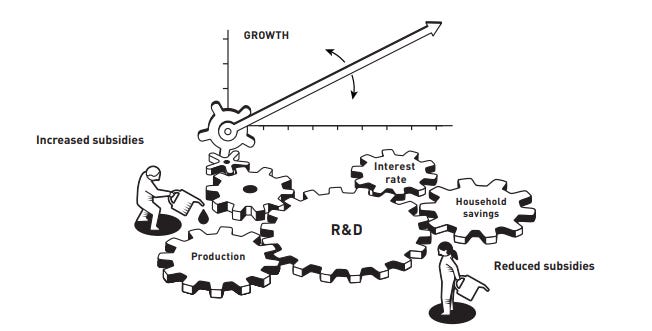
Aghion and Howitt’s big innovation (ba dum tss) was in turning Schumpeter’s poetry (or what passes for poetry in economics, which is prose) into prose, as in, math. Their “Schumpeterian growth model”, which was confusingly created at roughly the same time as Romer’s endogenous growth and the neo-Solow models featuring human capital, follows off Schumpeter’s ideas: because ideas can go old and become useless, businesses are overly incentivized to invest in research, since a high level of research across the market can threaten the current technology with rapid obsolescence. This means that obsolescence creates a negative pecuniary externality (that is, lower profits) to businesses from innovations, and hence a tendency for laissez-faire economies to generate too many innovations, i.e too much growth. This makes very important microeconomic predictions, because it posits that the structure of markets is really important for growth: particulalry, the less competition in an economy, the lower the incentives to innovate - which the Laureates find empirical evidence for1.
The Aghion and Howitt model is built off rejecting Romer’s “kumbayanomics” where everyone shares ideas and technologies in a world without lawyers and instead building a competitive one where every innovator has a dominant share on their market until a new innovator creates a new, better product that destroys the profits of the incumbent, who is rendered obsolete and loses market share to the entrant. This means that economic growth is driven not by innovations to existing business paradigms, but by new companies that have strong incentives to engage in “radical” innovation to capture the market. Incumbent, established firms tend to focus on incremental innovation to improve their own products, but can preemptively innovate to defend their position, by being the next innovator themselves. What this means, at a macro level, is that technological innovation comes in waves, where new firms show up to contest a market, establish dominance with new technologies (think Apple and Microsoft taking over from IBM), defend their own products by improving them but then lose relevance over time as newer, shinier things (like AI) show up to displace them. This shows up, conceptually, as a big jump, then smaller incremental steps.
But of course the question is how this happens specifically and practically, how companies turn ideas into new technologies and where these ideas come from.
Lever-ing up
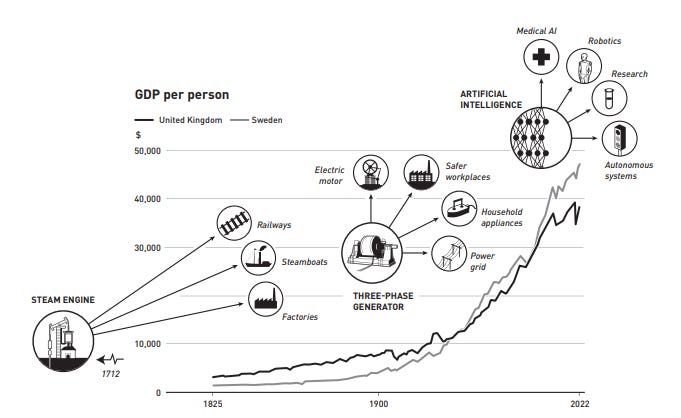
Now onto lucky Joel Mokyr, who got half the Prize all to himself. Surprisingly, his most famous work is not necessarily in research papers, but rather in academic books, particularly The Lever of Riches (which I read a few years ago) and The Gifts of Athena or A Culture of Growth, which I haven’t. The first book is very dry, being an extremely in-depth look at how technology progressed and built up upon itself for 2,500 years. It’s a very ambitious book and I’ll leave the tedious descriptions of medieval water mills to the man of the hour himself.
The big question isn’t really why economic growth comes from technology (that’s simple arithmetic known as far back as the 1950s), but rather how it sustains itself - it seems that, once countries reach the technological frontier, they stay there. Mokyr’s big contribution is that, unlike more traditional models where technology was developed by guys with white coats and clipboards, it comes from mixing scientific and technical knowledge. In Mokyr’s research (this is from Gifts of Athena so don’t get too pedantic if I’m just right), there’s two types of knowledge: propositional (the “what” and “why” knowledge, as in scientific laws) and prescriptive knowledge (the “how” knowledge - techniques, recipes, and instructions). The relationship between the two is most famously seen in Industrial Revolution, which grew out of both increased “theoretical” knowledge about things like gravity and fluids, but more importantly, out of the application of these developments into skilled craftsmanship. The core principles of the steam machine and its applications had existed for a long time (in fact there are blueprints from as far back as Ancient Greece for them), but the specific implementation was fairly novel, and required very advanced knowledge of the production process. This is to say, technology as a concept is kind of flat, because the more in-depth process of producing different types of knowledge and applying them in advancing ways.
Of course, this explains how knowledge is produced, but not why it is produced unevenly both across time and across place - why was the 1940s US more innovative than the 1970s US, or 1940s China? This is Mokyr’s aim in The Lever of Riches, which uses a very Lakatosian model of knowledge production: macro and micro-inventions. Macroinventions are big, radical breakthroughs hat shape the playing field, and represent a change in what technologies are even possible - think of the steam engine, internal combustion, electricity, the computer, and the internet. Microinventions, meanwhile, are the cumulative, incremental tweaks made to a macroinvention. Macroinventions are driven more by broad-based inquiry and microinventions by market pressures and profit seeking, but both are extremely important. The importance comes from the fact that, while macroinventions are obviously the wellspring of technology-based growth, they’re not really possible to create in a regular or foreseeable way: Mokyr’s slightly pessimistic thesis is that no society remains technologically creative for very long, so technological progress is not automatic or self-sustaining, and instead requires specific conditions to keep existing. He doesn’t go into much detail into what these conditions are in Lever of Riches, but it does discuss some possible conditions: reliable and trustworthy institutions of governance, a forward-looking culture, some background environmental factors (like disease, climate, and resources), and a social structure that allows for artisans and craftsmen to produce - we all know the story where the guild of scribes and religious officials banned the introduction of the printing press to the Ottoman Empire, and the Industrial Revolution would not have happened without the Enlightenment and the Scientific Revolution incentivizing both discovering new knowledge about the world and utilizing it for real purposes, and also certain government institutions (particularly the Glorious Revolution, stable property rights, and limited government) that allowed for these inventions to be commercialized, .
The last book we’ll talk about is A Culture of Growth, which goes into further detail on that question: under what conclusions does growth come forth? Mokyr’s central claim is that there was a “Republic of Letters” that came from the Renaissance, the Enlightenment, and in lesser part the Reformation. This was possible because of Europe’s political and geographic fragmentation, which meant that intellectuals persecuted in one jurisdiction could find sanctuary in another (Machiavelli fleeing Florence, Spinoza leaving Amsterdam), and that no single authority could suppress a new idea completely - in fact, great power competition made it more likely that leading lights would be allowed in. This “Republic of Letters” created a community that awarded prestige on people whose ideas were novel and truthful - for instance, the extensive cooperation and competition between Galileo, Johannes Kelper, and Tycho Brahe trying to figure out astronomical phenomena. Big intellectuals, like Copernicus and Francis Bacon (Mokyr loooooves Bacon, average Northern European amirite) served as “cultural entrepreneurs” or what we’d now call influencers, people who deliberately changed the beliefs, values, and preferences of the European elite. Newton and Bacon are particularly notable to Mokyr, who points out the set of values that took hold in England: the Baconian Program (knowledge should be used to improve human lives), the Newtonian Synthesis (the universe is governed by knowable, natural laws), and the virtuosity of research (discovering new things is a noble, prestigious activity). This required abandoning deeply held beliefs, like unlimited hawk tuah to Aristotle, stupid biblical naturalism and pastoralism, and weird pessimism around the future of humanity (this one was a bit warranted at the time2).
Conclusion
Aghion and Howitt find that economic competition and the incentives it generates to improve and innovate products is the ultimate driver of economic growth. Mokyr’s big theory is that it’s not just government institutions and political power (that’s last year’s Nobel), but also culture and the possibility of applying technology to the world for profit and fun.
The world is currently talking about two big things: the first is AI, obviously, and to a much lesser extent other new technologies, like MRNA vaccines or GLP-1 drugs like Ozempic, as well as renewable energy and electric vehicles. The second is the awful state of affairs in “Western” (whatever that means) politics, with new authoritarian forms of governance, intolerance, and illiberalism.
The big thing here is that the world we live in, one that is less equal than ever, more concentrated than any time in the last 100 years, more intolerant than in the past few decades, more pessimistic and zero sum than it’s been since the Great Depression, and very hostile to new technologies is one that is not friendly for economic growth and technological progress. Without support for scientific research and innovation (and not just words of praise - Aghion and Howitt mean money), immigration of top talent, and tolerance of people who are different from us, there’s not going to be any technological advancement. Chat, are we (as in everyone except China) cooked?
It’s since become a very contentious topic because there is some evidence pointing to it, but the evidence has a lot of issues not just empirical but conceptual: it’s hard to measure market power, and easy to measure concentration, but concentration doesn’t equal market power (this means that market share and market influence are not the same).
Linking to a very old post about Malthus not to like the Unabomber.
Some of the history is a bit off. The “oldest” growth model would be something like the Walras/Cassel/Von Neumann balanced growth model, then the similar Harrod Domar model, which is basically the thinking on growth that preceded Solow and that he was responding to in his 1951/3 papers. Then when the endogenous growth models came out later these early growth models got rebranded as the AK model. Solow wasn't all that impressed saying it was just the old models again (to be fair with some extra “microfoundations)
Also growth in solow model does not depend on the saving rate or population growth. Thats actually kind of the point.
Finally the idea of conditional convergence had/has pretty strong empirical support which is why Solow model became so widely adopted. The trick is to explain what determines technological growth AND convergence within the same framework
Very insightful. The growth culture aspect sounds intriguing.