
The Emperor's New Clothes
Portrait of Madame X The Everything App

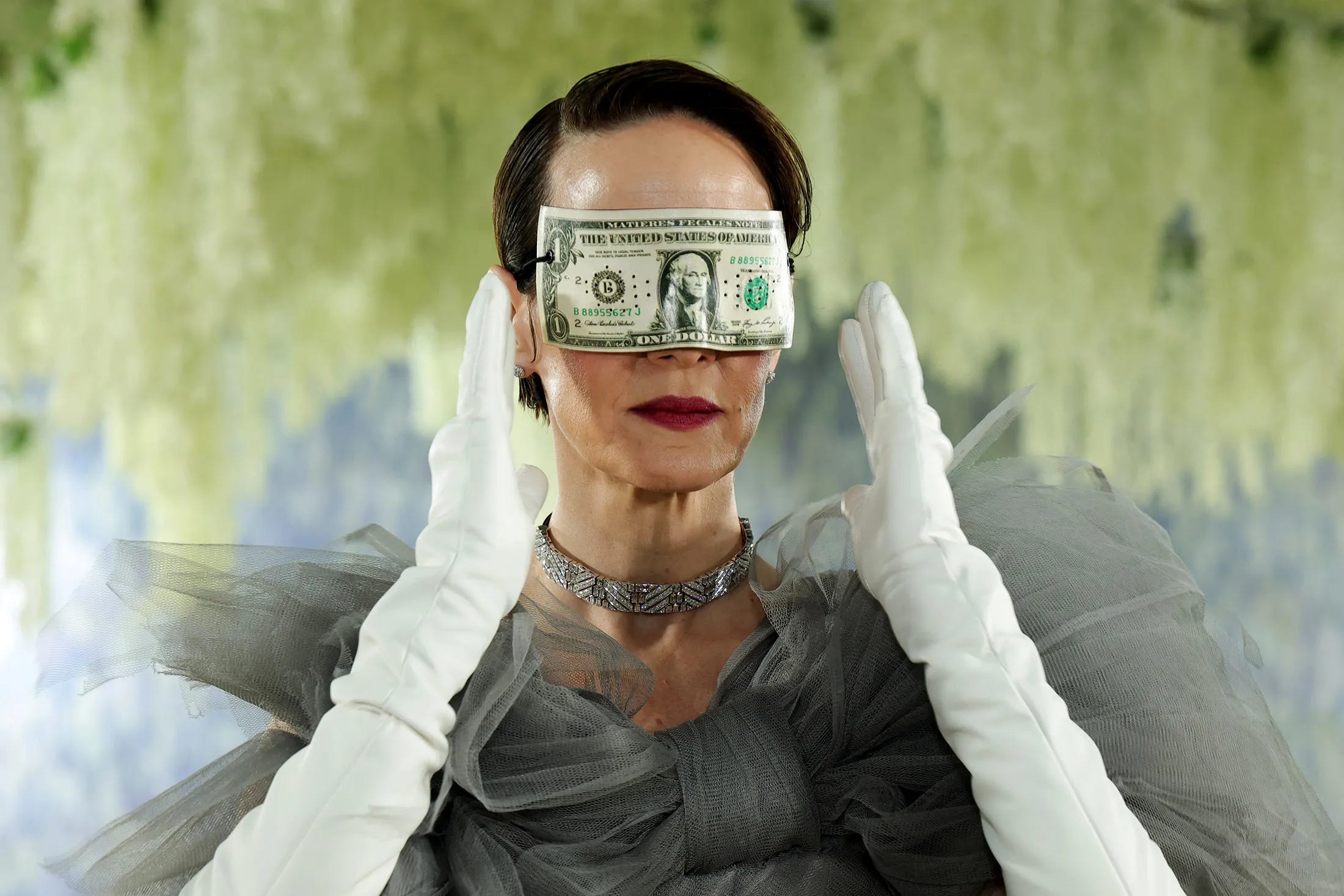
The Met Gala was last week (and I was too busy to write about it in a timely manner), and, as usual, started a lot of discourse. The Met Gala is the biggest night in fashion for the year, and usually one of the most controversial: how someone dressed, the theme (such as Karl Lagerfeld in 2023), but most of the time it’s the event itself. A viral tweet every year goes along the lines of “this is literally the Hunger Games”, complaining about the excess of the very rich and very famous wearing extravagant outfits for a photo op. What’s the deal with fashion’s biggest night?
The Met Gala (legal name: “Costume Institute Benefit”) is an annual fundraiser held in the first Monday of May by the Costume Institute of the Metropolitan Museum of Art in New York City, New York, United States of America. It’s happened all but one year (2020) since 1948, and most times it has had a theme centered around a concurrent exhibit at the Costume Institute: the 2026 gala’s was “Fashion Is Art” (the fame is a gun / sympathy is a knife / karma is a bitch / we are charlie kirk / mi es lei school of titles), after the exhibit titled “Costume Art”.


Well, it’s a bit silly to complain that couture designers use a high-profile museum fundraiser as a publicity stunt by sponsoring famous people wearing weird outfits. In fact the Gala was started to bankroll the Institute, which was founded in 1937 to preserve obscure but valuable garments by the New York City theater sector; between 1948 and 1973 it was only really a charity event, and started having a concurrent exhibit and a theme with that year’s The World of Balenciaga. The current state of the Met, as a gigantic item in the style calendar, is the culmination of a decades-long trend: since (longtime Vogue editor) Anna Wintour took over in 1995, the Gala became more and more central to fashion discussion and the fashion world, and by 2004’s Dangerous Liaisons theme it was clear that celebrities were treating it as a night to make a big splash, usually by wearing something bold and on-theme (before, only professional models really stuck to the specific theme of the year). 2016 was a pivotal year because it’s the year that supercharged the event: the moment that changed it from a sleepy event for fashion power brokers in black tie attire to a full-blown The Capitol extravaganza was Rihanna’s headline-grabbing Guo Pei look from 2015.
2016 was also pivotal for a second reason: the Costume Institute started over-targeting financially to save up a rainy day fund - it has accumulated 100 million over the last decade per the New York Times. Fundamentally, it’s a problem that the Met Gala is its only source of annual funding, because it costs multiple times its operating expenses for the year: the Times estimates that the Institute has expenses of USD 5 million a year, and the Met Gala costs tens of millions (particularly considering the sheer scale of the exhibit) and raises as much; instead, they want to slowly build up to around 170 million and then transition to a model more similar to the one the rest of the Met follows, of smaller, self-funding exhibitions with outside sponsors for a handful of blockbusters every couple of years. Hence why they need to not just keep up the show, but play it up: Anna Wintour almost certainly wants to leave the Costume Institute in shape before her imminent retirement. Thus, she probably put together what basically amounts to a scam on the sponsors: pay astronomically more for tables (prices have quadrupled per ticket in the last decade, compared to inflation of 39.5%) and raise more. This year, the Gala has raised 42 million this year, an all-time record, and probably bridged more than half the gap to financial independence.
So why is the Met Gala, a benefit for an obscure section of the museum, so controversial? Historically, the fact that private companies foot the bill and that it’s a charitable endeavor for a public institution that charges limited prices, hence why a number of elected local officials and progressive politicians like Alexandria Ocasio-Cortez and former NYC Comptroller Brad Lander (not to mention Kamala Harris as a surprise guest last year). The Mayor of New York City, in fact, has attended every Gala but one since 2002: the one exception is this year’s, since Zohran Mamdani announced neither him nor his wife were going. This isn’t the only high-profile absence: turnout of A-list celebrities and big fixtures on the whatever colored carpet was remarkably low this year; a protester was shooed away at the entrance by security; New York was blanketed in signs complaining about the Gala, and Abbott Elementary’s Lisa Ann Walter emceed an “Anti Met Gala” fashion show during the day.
So let’s address the elephant in the room, which in this case is wearing a rather ugly recreation of John Singer Sargeant’s Portrait of Madame X1: the Gala was extraordinarily politically fraught for the simple reason that its sponsors were Jeff Bezos and his wife, Lauren Sanchez on a personal capacity. Having a single individual be the sponsor is rare: it’s happened exactly twice since 1990, the other time being 2018’s Heavenly Bodies sponsored by the CEO of Blackstone. Bezos is extremely personally controversial, it seems, given his “donations” (read: bribes) to Donald and Melania Trump, his controversial moves at the Washington Post, and his alleged ties to ICE, as well as just his overall wealth in a time of anti-billionaire and anti-elite backlash. One such group, Everyone Hates Elon, had a video of Amazon warehouse workers blasted onto Bezos’s 120 million dollar Manhattan penthouse; another such stunt included leaving dozens of bottles of fake urine at the Met to protest the lack of bathroom breaks for warehouse workers. The controversy apparently blindsided Anna Wintour, even though it seems to have impacted the guest list: Meryl Streep, who was nominated for an Oscar for playing a barely fictionalized Anna Wintour in The Devil Wears Prada and has reprised her role for the sequel, declined to appear in the Gala for the first time ever in large part because of her personal distate for Bezos - even though, supposedly, the Gala was seen as a major moment for The Devil Wears Prada 2 marketing.2 Olivia Rodrigo, who didn’t go to the Gala but did go to the afterparties, posted on her Instagram story in support of the boycott (two days after) - all but confirming why she didn’t attend.
A lesser, but more successful, person would pinpoint this as an example of progressive self-segregation or a blatant case of liberal hypocrisy - we want billionaires to give to cultural institutions, but when they do, we hate them for it and call the event “tacky” and self aggrandizing. The entirety of the increase in fundraising comes from Mr and Mrs Amazon Prime buying the sponsorship from their own pocket. So what we have is, on top of the usual annual discourse, a gigantic backlash against a specific ultra-rich (conservative) man bankrolling a big event at a museum. Are people even right to oppose it?
Straight up Jürgen it
I ask [Riz] Ahmed whether he had any qualms about working with Amazon, given their links to worker exploitation across the world, and he goes quiet, before he leans in, staring intensely. “Fucking hell bro. I mean, I guess the question really is: where is the clean money? Show me where it is and where they’re handing it out. Follow the money. It never ends in a good place,” he says. “I guess that’s part of what the show’s exploring. And it really asks [the] question, when you step into the room, do you change the room, or does it change you?”
Interview with Riz Ahmed for GQ, March 2026
The most obvious counterpart to what Jeff Bezos is doing comes from Mister Beast. Mister Beast, for those who live more fortunate lives than me, is a youtuber who makes a mix of charitable videos and what can basically be described as prison torture content. His most obviously unethical content, things like “I locked up two people in an empty room for 100 days”, provokes much less discussion than his least unethical, which frequently involves things like bankrolling private medical treatment for disabled people and recording it - think “helping the blind see”. Looking beside the obvious “performing fake miracles to gain public support for a future political career” antichristy vibe, it is genuinely interesting to think about why it feels so viscerally wrong to do charitable acts for what amounts to personal gain and self-promotion.
Of course, the obvious counter to the idea that it’s bad to gain from socially beneficial goods comes from Adam Smith: “It is not from the benevolence of the butcher, the brewer, or the baker that we expect our dinner, but from their regard to their own self-interest. We address ourselves not to their humanity but to their self-love, and never talk to them of our own necessities, but of their advantages”. This is, at least to some extent, true, but it ignores that we’re discussing the exact opposite situation, one in which the baker and the butcher use the appearance of benevolence to sell bread and meat. I’m also not really sure that utilitarianism can give anything to this conversation: is giving more prestige and power to Jeff Bezos, again, a major donor to the Trump family (he’s currently thinking about rebooting The Apprentice starring Donald Trump Jr) such an enviable social benefit, especially considering the actual tangible utility produced is that a fashion museum with a 100 million dollar endowment has to wait two extra years to fund its own operations? So the question inevitably has to become, is it really possible to square the endless pursuit of individual wealth and success with universalist social aspirations the likes of which public museums have?
One thinker who was particularly concerned with this question was Jürgen Habermas, a German philosopher who died a few weeks ago at the ripe old age of 97. One of the major retrospectives of his work I read a bit of, Thomas McCarthy’s The Critical Theory of Jürgen Habermas, came out around 30 years into his career - but still a decade before his most important work, The Theory of Communicative Action. The other important summary, William Outhwaite’s Habermas: A Critical Introduction, came out in the early oughts, and still missed two important parts of his career: his late-in-life musings on Eurofederalism and his debate with future Pope Joseph Ratzinger (or his, seemingly quite impressive, work on the history of philosophy, that he finished less than a year ago!) Anyways, Habermas was German and grew up during and after the Holocaust, and was a member of the second generation of the Frankfurt School, a group of highly academic Marxists who wanted to rehabilitate the great master’s theory by integrating it with psychoanalysis and classical sociology to understand, in particular, the phenomena of false consciousness and how the death drive could overtake the superego and produce something like Nazism. In short, they were basically the Chicago School of Marxism.
Habermas’s mission in life, or at least the first like 70 years of it, was to integrate Germany’s great two thinkers, Karl Marx and Max Weber (he did not follow recent Econ Twitter debate). A TL;DR of Marx is that, across history, the most important thing is basically technology, which he calls the forces of production, which distributes profits and resources according to the specific power relationships between individuals (the social relationships of production); a combination of the two produces an ideology that justifies them, known as the superstructure, and all put together they make up the mode of production: capitalism, feudalism, slavery, and, in the future, socialism. The socialist revolution was inevitable because capitalism contained at its core a fatal contradiction: value is produced by labor, but property is owned by capitalists who don’t produce value, so the social conditions of reproduction (i.e. the standard of living) is not matched well with the creation of value. The difference between the two results in a bunch of social pathologies, like underconsumption, alienation, and something called “lumpenization”. Max Weber worked after Marx, which meant he actually responded to many of his ideas, which during his time were extremely politically influential. Weber criticizes Marx as someone who focused too much on economic class (labor and capital) as opposed to culture, ideas, and religion, as well as status and political power. For instance, Weber most famously argued in The Protestant Ethic and the Spirit of Capitalism that the Protestant Reformation was responsible for the emergence of capitalism and not just the economic features of feudalism, since Calvinist theology (as well as other protestant sects of the time) argued, successfully, that earthly success signals divine favor and thus set the stage for a “profit motive” to be allowed in individual psychology. In particular, Weber detailed that power is also separate from authority and legitimacy, and that the three types of legitimate authority are traditional (think of a tribal monarchy, or a religious order), charismatic (pretty obvious), and rational-legal (bureaucratic norms and institutions). The big idea here is that Weber saw modernity as the process of rationalization, the replacement of all traditional and charismatic modes of life with calculation, efficiency, and universal rules grounded in logic. Modern states, in general, have been on a long march to the supreme control of rational-legal authority, such that power ought to be exercised through impersonal procedures. Importantly, this isn’t any reason, but specifically instrumental reason (called “formal-procedural rationality”): a form of rationality that is interested exclusively on efficiency, connecting means with ends in the straightest possible line. This stands opposed to “value rationality”(substantive-value rationality), which is oriented towards things relative to their intrinsic worth and without considering consequences. In modernity (read: rational-legal authority), instrumental rationality dominates, which can lead to debates increasingly marginalizing ends - which leads to something called disenchantment, meant quite literally: a world without magic, where everything is understood but nothing is valued. Weber was worried this would work as an “iron cage” (or a “cog in a machine”) where people know exactly what they’re doing but not why or what for; this should produce, in turn, problems legitimizing convictions that people hold anyways, which Weber compared to a polytheistic religion where all the gods are at war against each other - resulting in basically interminable paralysis when people want to take meaningful stances (“sensualists without heart” and “specialists without spirit”).
There’s a lot to critique in both Weber and Marx, but they have a lot in common: in particular, both rely pretty heavily on what’s known as historicism (the idea that social phenomena are determined by their specific historical context and thus that the development of historical contexts is the most important rule for understanding history), except, ironically enough, for Weber when it comes to capitalism, which he saw as somehow inherent to human economic activity, which kinda contradicts the Protestant Ethic thesis and the theory of rationalization. I mention this point (raised by Ellen Meiksins Wood in Democracy Against Capitalism) because it’s relevant to another form of thinking Habermas engaged with: continental philosophy. “Continentalism” is one of three major branches of contemporary philosophy (besides Marxism and analytic philosophy) and it basically emerges in the late 19th century as a way to revive a philosophical tradition built around interpretation of meaning rather than strict logical and scientific formulations (“the method”) which led to entire fields, like aesthetics, becoming barren, subjectivist wastelands. For contiental thought there’s basically zero difference between historicism and subjectivism, because both reject the existence of a permanent truth, and they use this line to also attack the limits of “the method”, because it relies on premises it cannot sustain on its own. The important thing here is the concept of phenomenology, created by yet another German, Edmund Husserl, which basically relies on sidestepping thorny metaphysical questions about “reality” and instead focusing on the world as it is perceived consciously but without accepting contingent factors (think of those cultures that describe oranges as “red” because they don’t have a word for the color orage: are oranges and apples actually the same color? No! The similarity is contingent). Instead, continental thought relies more on a type of thinking called “hermeneutics” (more on this next week 👀), which is less focused on the ability to prove things through strict logic and more on interpreting the meaning of text and speech acts through engagement with them and acknowledgment of our own and the author’s prejudices of various kinds.
The takeaway is something called “the lifeworld”, which is the world as it is perceived by all the members that live in it without these contingent factors - the name is a bit silly and evokes a video game like Animal Crossing or Tomodachi Life, because that’s basically what it refers to, a sort of universal Star’s Hollow. Habermas combines these three influences with yet another important thinker: Emile Durkheim, another father of sociology (but this time a Frenchman). Durkheim’s big move was that society is an emergent property of the collection of individuals because “social facts” (institutions, norms, beliefs) are external to individuals but internal to society as a hole, which is the basis for separating sociology from psychology. This means that social change can be not accompanied by individual change, which means society can set itself off into a complete breakdown: people stop knowing what to do or what to believe, which Durkheim calls anomie, and which can result in extremely self destructive or violent behavior. And lastly, he also drags in the Frankfurt School critique of rationality: specifically, they criticize what they call “instrumental reason”, per Max Horkheimer’s The Eclipse of Reason: as a TL;DR, he separates “value rationality” in two, subjective and objective (subjective is for pursuing your own values and interests without considering their moral valence), and basically posits that instrumental and subjective rationality have replaced the question of how to lead the good life and how to live in a good society with “how do I do what I want to do as quickly as possible”, which eliminates concerns about values or justice beyond considering them yet another subjetive preference. This excessive rationalization of society eventually destroys itself, because it produces a world in which nothing can be criticized beyond as a means to some particular end because any substantive criticism would need appealing to objective higher values that reason has siloed off from itself.
Well, one hundred million pages later, what does Habermas actually say in his grand quest to combine Marx and Weber? Well, first, let’s start with the lifeworld: in continental thought, it’s the “background” for all interactions, containing a shared pool of meaning, norms, and communicative practices. In his early work, Habermas skewed both very Weberian and very Frankfurt: starting with the Enlightenment, a novel space called the public sphere developed, where private individuals could argue relatively freely about matters of public political interest, with a structure designed to ignore the status, wealth, and prestige of people, what he called rational-critical debate (of course, women, the poor, and minority groups were not included). This was a space completely devoted to objective value rationality, so to say; however, the emergence of mass capitalism destroyed the public sphere that had emerged alongside its creation. Mass commercial media had to focus on economic viability and not on argumentation; political parties started focusing on following instead of leading public opinion; the role of advertisement and sponsorship began constraining public media for communication. Habermas calls this process the “refeudalization” of the public sphere: just like in the Middle Ages you had powerful lords being catered to and entertained by artists and intellectuals, they do the same now, with a passive public cheering or jeering instead of engaging in or with that work. This works from Habermas’s (rather complicated) theory of interests: Knowledge and Human Interests is basically a book about how to solve a variety of epistemological questions in continental philosophy, and his proposal is that different forms of knowledge reflect different cognitive interests (think of them basically the way people talk about “love languages” on TikTok), which are both socially reproduced and a constitutive part of the identity of all humans. There’s technical interest (pretty self explanatory), which produces emprical-analytic knowledge; there’s practical interest (focused on understanding and transmitting certain values across generations), which feeds the historical-hermeneutic sciences, and there’s emancipatory interest, which is basically just left wing Critical Thought. The claim is that all knowledge is actually shaped by interest which is shaped by certain social and political structures, which systematically distort communication and reflection - think of how a person with an eating disorder would see themselves as much fatter than they are (Habermas discusses psychoanalysis but let’s not go there). This leads to the concept of the Legitimation Crisis, which is at the same time Marxist, Weberian, Durkheim, and sometimes incorporates this concept: because legitimacy has a lot of power through discourse, then widespread economic or social crisis that lead to breakdown or disillusionment needs to involve a discursive component to be resolved. People thinking they can solve a crisis of systemic legitimacy with technocratic tinkering don’t understand the situation they’re facing and the type of knowledge they need to use. In particular, the knowledge and interests of civil society (which are historical or emancipatory) that try to reach a compromise start being steamrolled by the instrumental need for a resolution by the state and the economy. The incompatibility of private, “subjective” value rationality with broader social aims; at the same time, the universalist value judgements of liberal universalism clash with the “greed is good” privatism of market economics and traditional ways of life that are rapidly uprooted and/or consumed.
Habermas developed this broader, more convoluted theory to try to expand on Marxism and explain the seemingly incoherent political economy of fascism with its very aggressive war on only some segments of civil society. But that reveals the biggest problem with Habermas and the oldest critique of him: if social power already shapes interests and knowledge, which themselves produce discourse, then why do the wealthy need to feudalize the world? If their power would come from discourse, then they already have it without a need for court intellectuals; if their power doesn’t come from discourse, then where do they get the power to feudalize the public sphere? Put another way, early Habermas doesn’t have a coherent theory of power: in the words of boygenius, it relies on the very rich taking from people something people would have given to them.
Latter Habermas starts with engagement with two new sources: the first is Anglo-American philosophy of language in the analytic school, and the second is the sociologist Talcott Parsons. Parsons tried to unite the very obvious similarities between Weber, Durkheim, and other classical sociologists like Georg Simmel, by focusing on “systems theory”: all social systems have to have an economic system, a political system, “civic systems” (community, norms), and culture (this is called AGIL after adaptation, goal-attainment, integration, and latency, the functional prerequisites they fulfill). Specialized subsystems handle each function in such a way that they produce means of communication that can allow for coordination without constant communication or without needing to agree with subjective values: in particular, money and (political) power. This makes society a self-regulating system capable of equilibrium without a central balancing power, but it can break down in a variety of ways. Habermas draws from this idea, and utilizes the analytic concept where all speech is a type of action (locution, aka the content, illocution, aka the action, and perlocution, aka the effect on thelistener) which has three implicit conditions for validity (truth, rightness, and sincerity) such that the rationality of communication is presupposed by communication itself: a speaker intends to produce a belief in a listener by trying to understand how this intention will affect the listener, including by acknowledging that the intention of persuading itself is part of the effect. This means, to put it more succintly, that the norms of speech are inherent to speech itself, because no speech that tries to do something can also try not to do it while remaining valid. This also involves abandoning some continental claims about language and interpretation, and also led to a pretty cantankerous debate with Gadamer over whether being a good writer was fascist or not (Habermas argued it was because of perlocutionary acts bypassing rationality3).
So what this means is that Habermas addresses a lot of the problems pointed out in his early work (most importantly, that critical knowledge couldn’t free itself from its own biases, as well as the power issues) by changing the groundwork: the public sphere is built on communicative reason, the idea that all statements made are also made with the sincere intention to defend them rationally if interrogated instead of pulling rank or guilt tripping someone. Because the lifeworld is a “pool” of shared cultural values and norms, every genuine act of communication draws on it as part of speech acts, and because speech acts can which means that the lifeworld is both a medium and an outcome of communicative action. The three main components of the lifeworld (cultural knowledge, legitimate norms, and personal identities) then shape community culture, society, and people. Importantly, disturbing these processes produce social patholoties like loss of meaning, anomie, and identity crises. This is where Parsons comes in: at a certain scale and a certain complexity, societies cannot be organized just through rational deliberation in the lifeworld. Instead, you need steering media, money and power, that coordinate action without the need for purposeful communication - if you want to buy something you don’t need to agree on the inherent value of the transaction as per social traditions. But this also, and especially in the realm of power, separates coordination from deliberation in way that permits for more social complexity and more differentiation between social spheres: between science and religion, between the sciences, between subfields of the sciences, etc. This also makes it so the truth of specific claims can be questioned without questioning foundational social values: compare the debate over heliocentrism with the debate over whether Pluto is a planet (well, bad example).
But this complexity leads to autonomous systems of money and power, with their own internal logic and their own imperatives, to begin needing to restructure the lifeworld itself to achieve those aims. For example, allowing for too much civic dissent can be seen as hindering governance. Thus emerges the redux of the feudalization of the public sphere: the colonization of the lifeworld, where money and power begin supplanting communication in order to achieve their own aims. The problem is you can’t transmit culture with money or form a society by just ordering people to do it, producing serious social disturbances: cultural impoverishment (replacing meaningful traditions with slop); anomie, and psychological pathologies. This means that inserting money and political pursuits into most social and cultural contexts doesn’t just devalue them; it destroys them basicallly completely, structurally damaging the conditions of social life. Importantly for Habermas, alienation and other traditional Marxist diagnoses are part of the problem in the same way that Weber’s disenchantment and Durkheim’s anomie are, and which in an extreme case leads to something like Nazism.
It’s pretty obvious how this figures into Bezos: cultural institutions like the Met Costume Institue participating in shaping and transmitting important cultural norms in certain fields of human endeavor, particularly fashion, as well as the arts more broadly. This has to come from careful deliberation around social norms and not from efficiency in fundraising or chasing opinion polling. But involving the personal fortune of Jeff and Lauren Bezos bypasses this deliberation and instead puts the question of “what are the norms of fashion” into the hands of a billionaire whose pursuits are money and power, quite openly. Bezos gutting the Washington Post to steer its coverage in a politically favorable direction or using Amazon Prime to bribe Melania Trump or contributing to balls and ballrooms to curry political favor makes it very clear that his involvement in the superbowl of fashion is completely politically directed and not part of highminded charitable goals. They are, instead, part of the colonization of the lifeworld: dipping our toes in the subjugation of one of the finest public museums on the planet in the service of the personal aggrandizement, at best, the enrichment, at the likeliest, and the authoritarian power consolidation, at worst, of one of the richest men on the planet. The idea that the extremely wealthy are seeking to utilize their money explicitly to consolidate political power is pretty undeniable at this point. The most obvious part is through their influence over politics and institutions: they’re spending a lot of money.
It’s all Greek to me
That Habermas died recently gave everyone an opportunity to give their opinions on him and his legacy: Hans Kundnani at Jacobin criticizes his Europeanism and support for Israel in the context of his other work; John-Baptiste Oduor questioned in an ArtReview piece how much his work managed to integrate facts with norms; this older piece by Raymond Geuss for The Point questions the centrality of language and discourse; for a positive one, Matt McManus (also at Jacobin) discusses how his thinking sought to restore rationality and discussion to their emancipatory potential.
But I thought the more interesting piece was this one by Aidan Regan at Democracy Challenged, which asks the question of political economy: how, exactly, can money colonize the lifeworld. To gain a more solid conceptual grounding, Habermas moved away from the philosophy of the subject to the philosophy of language, which enabled him to base his political theory on speech actions but also meant he couldn’t really incorporate power into the formation of speech very usefully. Even when he reformulated the legitimation issue into being about distortion from money and power, Habermas couldn’t really put together a how of that happened. In her obituary for him, Nancy Fraser more or less makes the same critique - too much “attempts to establish ‘normative foundations’ for critical theory in the anthropological depths of a putative human disposition to seek agreement via communication”, too little money and power.
Well, what does it mean for the lifeworld to be colonized by the forces of power and wealth? You can ask the five graduate students who the United States government attempted to deport (mostly unsuccessfully) for their involvement in political activism, in one example almost entirely because of (completely correct, besides lawful) criticism of Israel on a college newspaper. Or the 600 people fired for criticizing Charlie Kirk in various degrees of good taste when he was killed which, while awful, is legal - in one case, a professor was rehired and given 500,000 dollars as compensation over wrongful termination. A number of workplaces developed rules around employee social media conduct, and many such policies were enacted after October 7th 2023. On the other hand, you have the Cinnabon employee who got fired for insulting a Somali customer with racial slurs, or a man who got suspended, and nearly fired, for heckling Donald Trump when he showed up to his workplace. What’s the difference? The first group of cases involved political speech on a person’s own private time; the second group, on the clock while at work.
Most of these examples come from universities, such as a professor who was forced to apologize for praising pro-Palestine protesters in a speech, or media, like Taylor Lorenz, a journalist who was allegedly fired from the Washington Post after privately posting on her close friends Instagram story that Joe Biden was a war criminal and then lying about it to her bosses (only the latter part, really, ought to be a hot-water-at-work offense). This is for a pretty paradoxical reason: people in “messenger class” positions have both more and less free speech than most other people, beyond their exaggerated interest in each other. Sociologist Musa-Al-Gharbi points out something pretty obvious: these people’s entire job is expressing themselves (which tends to select for pretty unusual types of people), and not only that, but they also have a much wider ability to do so than, for instance, their peers in other country - because the way American first amendent jurisprudence has been shaped over 250 years, but also because they tend to value expressing themselves very highly and have, across time, bargained quite strongly to preserve that right. But, on the other hand, feminist philosopher Amia Srinivasan notes that academic freedom is more constrained than freedom of speech, because it requires allowances for content-based discrimination on official speech - noting: “As an academic, I have no right to be exempt from my colleagues’ criticisms or public condemnation; I cannot insist that they attend my lectures, or socialise with me; and I certainly cannot stop them from decorating their offices as they choose.”, as well as “…indeed the whole point of academic freedom is to protect academics’ rights to exercise their expert judgment in hiring, peer review, promotion, examining, conferring degrees and so on.”. The fact that academics and journalists have extremely wide berths to make political statements but also the substantive content of most of those statements is actually directly impactful on their careers (think of the prospects of a global warming-denying climatologist in mainstream academia) results in extremely bizarre behaviors; one professor Srinivasan mentions is Nancy Fraser, who had a job opportunity withdrawn over a statement criticizing Jürgen Habermas for his defense of Israel’s genocidal military actions and its ethno-supremacist policies. But something that both Al-Gharbi and Srinivasan note is that the specific economic conditions of academia are a defininig factor for how speech-related controversies go: Al-Gharbi estimates that tenured and tenure-track professors have a chance of 1 in 200,000 for being fired but contingent faculty have, give or take, a 50% chance of being fired: such as the recent case where a student filed a complaint against an Oklahoma professor and a TA for giving her a 0% on a truly terrible essay on transgender issues; the professor was not disciplined, while the TA was fired. Srinivasan wraps up a critique of transphobic moron Kathleen Stock receiving a title of nobility by saying: “What would a government seriously committed to academic freedom do? (…) it would scrap student fees, thereby stopping students from seeing themselves as consumers entitled to having their preferences met, and universities from acting like commercial service-providers competing for student pounds. It would take measures to fight precarity among university workers, supporting academics’ calls for fair wages and a reduction in casualised contracts.”
In a recent piece in The Argument, Matt Bruenig makes a pretty clear case to this regard: “cancel culture” is an outcome of a combination of at-will employment with free speech. It should be, in his view (and mine), plainly illegal to fire someone like Taylor Lorenz for her private Instagram posts. Lying about them, or insulting a customer, or violating university rules around student grade disclosures is a different thing. Going back to Bruenig, “One of the key critiques of capitalism is that employment relationships are not really voluntary. They are coerced by the fact that employers control the productive instruments of the society and workers need access to those instruments in order to generate the income required for their survival. (…) the gatekeepers of things like employment, housing, education, and public accommodations wield so much practical power over others’ ability to live free and full lives that this power must be constrained by rules outlawing discrimination along certain axes like race, gender, religion, age, and disability status, to name a few.” His essay ends with a callback to the opening anecdote: a law school professor saying Bruenig’s career would benefit from not advocating for socialism online; his conclusion is that, without clear free speech protections introduced in workplaces, “…random people occasionally suffer huge labor market penalties for internet comments, while the more cautious give up public political participation altogether.”
A similar case is made by (also socialist) historian Ellen Meiksins Wood in Democracy Against Capitalism; the book’s whole aim is to restore the idea of class to be the centerpoint of politics, dealing with various intra-Marxist debates between people who have initials, the previously cited digression on Marx and Weber, a meh chapter on identity politics, and two very good ones about Ancient Greece and the American Revolution. The one about Ancient Greece is more relevant here, and shares a lot of its premise with a 2017 article in The Atlantic by political theory professor Teresa Bejan. Bejan’s article notes that, in Ancient Greece, there were two concepts of “free speech”: parrhesia, which Bejan focuses on and refers to “the license to say what one pleased, how and when one pleased, and to whom”, and isegoria, which means “the equal right of citizens to participate in public debate in the democratic assembly”. The former is the one usually invoked in the free speech debate, for better or worse. But the latter is a lot more important, because it doesn’t refer to the ability to say whatever you want, but rather, to the ability to say it in a public setting. In Greece, going back to Wood, citizenship was rooted in membership of the community who performed labor, where the central value was eleutheria, the ability to live freely without a master (Aeschylus in The Persians: “to be an Athenian citizen is to owe no service or deference to any lord”); Aristotle, an opponent of whatever passed for democracy in Athens, actually used this notion to his favor - by granting that democracy was the proper system for those without masters, but alas, Athenian democracy included plenty of people who did have them based on their economic dependency on others. Regardless, Wood notes that isegoria was such a central part of Athenian democracy that they were largely understood to be synonymous; it involved a positive right to address the public assembly without considerations for the station of life, which presupposed the equal civic wisdom of all citiens and their equally valuable contriution to collective decision--making; in fact, the oldest known debate on democracy, Plato’s Protagoras, starts off between Socrates and the titular character on whether virtue can be taught such that shoemakers ought to be allowed to speak about naval policy alongside admirals and ship captains. Very few public offices were elected, with most being drawn by lots; the default assumption was the equality of competence among all citizens, except for very narrow positions such as military command. Wood states: “In Athens democratic citizenship meant that small producers, and peasants in particular, were to a great extent free of ‘extra-economic’ exploitation. Their political participation – in the assembly, in the courts, and in the street – limited their economic exploitation. Political and economic freedom were inseparable - the dual freedom of the demos in its simultaneous meaning as a political status and a social class, the common people or the poor; while political equality did not simply coexist with, but substantially modified, socio-economic inequality”.
This is, I think, what is missing on the typical stale points about free speech, which fail to mention this even in the rare cases they mention class at all: different amounts of money and power result in different amounts of speech. Larry Ellison gets to buy whatever tv stations, film studios, and social media apps he (and the Saudis) can afford; you get to not talk at your local zoning board because they host all their meetings at a time when you’re on the clock at work. In this sense, substantial inequalities in wealth and lax regulation of the media market mean that the rich have a right to a megaphone for all their views: Elon Musk turning Twitter, a valuable public square, into a Nazi cesspool; Bezos and the Ellisons buying media to turn it into propaganda outlets for pro-Israel conservatism. A recent free speech controversy, covered by one of Srinivasan’s two pieces mentioned previously (the one about Israel), was Jodi Dean, a professor at a liberal arts college who was suspended for a year for writing a blog post that most people would understand celebrates the October 7th terrorist attack (which is BAD and antisemitic). Interestingly enough, Dean was also quoted in one of the pieces I read for background for creating a reasonably useful concept: communicative capitalism. Citing none other than Habermas, Dean mentions that “In sending a message, a sender intends for it to be received and understood. Any acceptance or rejection of the message depends on this understanding. Understanding is thus a necessary part of the communicative exchange. In communicative capitalism, (…) [a] contribution need not be understood; it need only be repeated, reproduced, forwarded. Circulation is the context, the condition for the acceptance or rejection of a contribution. Put somewhat differently, how a contribution circulates determines whether it had been accepted or rejected.” This means that the internet, infrastructure meant to permit further understanding, reduces the ability to communicate, since each piece of communication is made less valuable by the total number floating around, it replaces actual engagement with meaningful causes (think poasting versus protesting - not that Professor Dean needs any lessons in the perils of interpassivity), and forecloses the ability to discern between threat and disagreement. In this sense, free speech isn’t necessarily suppressed, but rather overwhelmed by its own uselessness. And, importantly, wealth inequality and private ownership mean that what speech is able to circulate is not itself a neutral choice; the owners of tech platforms can, as they in many occasions have, put their finger on the scale of what speech is allowed and what speech can gain traction on their sties.
The missing piece of the Habermasian puzzle is the lack of a substantive consideration of what Marx called the central contradiction of capitalism, the possibility of the owners of the means of production to control the means of social reproduction; in plain English, that your livelihood is in the hands of a specific private person. This goes against a notion of free speech based on the right of every citizen to speak as an equal to each other, which was foundational to Athenian society, and which would imply an absence of coercive power relations between citizens (slaves, for example, and foreigners enjoyed isegoria, even if women did not). In contrast, Wood claims, American democracy is built around an exclusionary notion of citizenship that diminishes, rather than promotes, civil society engagement in politics (an intentional choice by Madison and Hamilton to preserve property) by allowing for substantial inequalities in the right to self expression and political participation. In the present, and in other countries, a marked lack of worker protections and a greatly diminished social safety net, among other factors, mean that your speech rights are curtailed by your employer’s beliefs: for example, Walter Isaacson’s Elon Musk mentions how the richest man on Earth covertly threatened to void stock options if Tesla employees unionized, which was both illegal and highly effective.
Hype or hyper
The trendy book to talk about now is Anton Jäger’s Hyperpolitics, which I haven’t read yet so I won’t comment too much about (mostly because none of the reviews I’ve read mention some important parts of the story and I don’t know if they’re not in the book or, what’s more likely, they’re not of a lot of interest to them - though they aren’t brought up either in the 2024 NLR article about the subject). The TL;DR is that politics has been replaced with something called “hyperpolitics”, best exemplified by Yanis Varoufakis and Alexis Tsipras: be mad at everything, rally a big mob, get into power, accomplish nothing. Basically every mass movement of the last 20-ish years is hyperpolitical: the Yellow Vests, Black Lives Matter, Occupy Wall Street, the Arab Spring. Jäger explains “hyperpolitics” with two variables: politicization (basically, how intense ideological disagreement is) and “institutionalization”, the more important variable, which roughly tracks civic participation and formal membership of organizations (eg. labor unions, churches, sports leagues, etc.). To him, both were on a long, downwards trends from World War Two to the 1990s, and reached relative minima in the “End of History” era: no politics, no organizing, no nothing. Politics began to become completely dominated by professional consultants, and policy was siphoned off to unaccountable bureaucracies; civil society was replaced by professionally run NGOs. However, two factors conspired to end politicization: social media, and the Great Recession; the problem was there was no institutional channel for collective action. William Davies writes in the London Review of Books: “… while politicisation has continued to escalate, institutionalisation is at a low ebb. This is what distinguishes hyperpolitics from the mass democracy of the mid-20th century. Symbolic political gestures are now commonplace, but paid membership of organisations and parties has plummeted. The left has failed to find a replacement for trade unions as a basis for collective action in civil society. Political movements are easy to join, and just as easy to leave. The chasm between politics and policy widens, as the former becomes a fruitless stream of outrage with little or no practical consequence.”
As quoted by Daniele Palmer in Commonweal, Jäger writes: “For the left to catch up with its rivals, will require a philosophical reckoning with the historic decomposition of voluntary association”. His main inspiration in thinking about this is the political scientist Robert Putnam, of the famous Bowling Alone thesis: ever since the mid 1950s, community groups and civic ties and participation had declined in the United States, resulting in an atomized society and an atomized polity. In detail, Putnam’s theory is centered on social capital (the networks of relationships and trust that enable collective action) collapsed in the second half of the 20th century, such that people were doing things inside society rather than with it - the titular example, going to the bowling alley on your own, rather than as apart of a league. Putnam distinguished two kinds of social capital, bonding (that tied groups within each other), and bridging (that tied them to each other); it was the latter kind that collapsed, and it was the one that allowed for democratic participation. Putnam attributed four causes: generational change, mostly, which also did not reproduce its own social norms to their children; then, he mentioned television and the privatization of leisure (in his latter work this expanded to the internet and social media) - the more people stayed at home, the less they engaged with their communities; then suburban sprawl and car-centric urban planning; then work and time pressure, particularly in a two-income household.
Other social scientists expanded on Putnam’s thesis: Theda Skocpol, a sociologist, added that in the same time the composition of the associations also changed, since the major cross-class organizations were replaced by white-collar NGOs where people primarily engage by donating money rather than deliberating, going to meetings, or negotiating, which are core civic skills highlighted by, for instance, Alexis de Tocqueville. Similarly, political scientist Eric Uslaner developed it a bit more in depth, distinguishing between particularized trust (I trust people like me) and generalized trust (I trust everyone), and that the latter kind, which is the one Putnam and the gang care about, correlates strongly with economic equality and standards of living; in large part, Uslaner’s work (which tracks fairly strongly with what I’ve taken from the economics literature) points to the fact that bowling leagues and barbeques are nice and all, but the underlying distribution of resources has to allow for the creation of social ties and community bonds in public spaces first. Likewise, Putnam’s own update to his original book, Our Kids, focuses on inequality as well, and quite heavily: the class gap in institutions like churches, sports leagues, PTA membership, and “scouting” widened significantly since the 1970s - the children of college educated parents are around 66% more likely to participate in them than the children of working class families regardless of the child’s preferences. This is only partly a financial story: Putnam attributes the decline in lower-class “civic capital” to lower social ties with other members of the community, which is the mechanism to transmit information about the value of, say, extracurriculars or whatever. This shows in the work of yet another sociologist, Robert Sampson, as well as Raj Chetty over at Opportunity Insights: social and community capital are very closely correlated with poverty and racial segregation at the neighborhood level regardless of individual characteristics, such that moving to high-social capital areas increases your economic possibilities and civic behavior, and living in a low-social capital one hinders it. Thus, growing up in a community with more socioeconomic diversity is associated with higher socioeconomic mobility - and direct social contact is key, as shown in a famous study finding that a Starbucks opening in a neighborhood results in higher rates of entrepreneurship explicitly due to its functions as a third space. Chetty, in particular, also emphasizes interclass friendships and social engagement generally.
This brings us to the obvious: social media. The decline of socialization, dating, sex, and a variety of social and therefore civic behaviors has been, at this point, I think fairly well documented. There’s a pretty good chance it revolves around online life, particularly how these platforms are designed to be addictive: digital media uses a distinct psychological trick, flow, as laid out by Jay David Bolter’s The Digital Plenitude (a book from 2016 that has been inexplicably very trendy in Argentina for the last six months). The concept of flow, coined by psychologist Mihaly Csíkszentmihályi (pronounced six cent mihaly) refers to a state of profound, prolonged focus. Flow can only be achieved with small, procedural tasks that have immediate payoffs with a clear cause-effect and cost-reward relationship. Compare The Secret Agent, a very slow burn “iceberg theory” drama about an ex scientist fleeing a shambolic death squad after a grant dispute where every single detail either matters or pays off and the ending is profoundly inconclusive, with scrolling TikTok: you pay attention for a little bit of time the whole time, if you don’t like a video you scroll down, and every video is optimized to make you watch it. Usually, this happens by inciting some instant emotional reaction - which happens to almost always be a negative emotion. This both means that people become less capable of relating to one another and, most importantly, that the “higher” forms of media (even the not particularly stimulating political television of the 90s and 2000s) gets replaced by lower and lower content. A recent addition to the literature of flow comes from columnist Derek Thompson’s Substack: citing researcher Shishi Wu, Thompson highlights passive flow in particular, which has three main features: “users engage without clear goals”, users “lose self-awareness (…) and disconnect with the world around them” and “don’t just spend more time than they intended on the site, but also they lose track of time entirely”. Kind of obvious how the latter two impact civic and social engagement; the former, especially combined with algorithms, is a bit more of a mystery, but one that can be ellucidated by a 2017 book by Cass Sunstein (ugh) called #Republic (double ugh). Sunstein’s book makes the case that a healthy democracy requires citizens to encounter unplanned information and unwanted perspectives (what he calls “serendipitous exposure” and what other more recent perspectives call “friction”), but platform design actively prevents this, locking users inside algorithmic echo chambers instead.
The civil society question, however, is extraordinarily fraught, with two competing definitions: Marxist theorist Antonio Gramsci (and some liberal thinkers like Norberto Bobbio), have seen civil society as the battlefield of political action: NGOs, churches, museums, etc that reflected the ideological underpinning of society given the relative power of political blocks. On the contrary, more traditional liberal thought (David Hume, Adam Ferguson) sees civil society as a way of translating deep-seated political differences, such as religion or how much power the Crown should have, away from war and towards discursive processes. In particular, Henry Farrell cites philosopher slash anthropologist Ernest Gellner, who saw it as part of liberalism’s rise during the French and English wars between Catholics and various factions of Protestants: quoth Farrell “The result was not just that religious and doctrinal disagreements became matters of private conscience and peaceful social activity. It was the creation of a new kind of society in which coercive force was centralized in the state, but was counterbalanced by economic and social pluralism. State power only went so far. People could, within reasonably broad parameters, choose who they wanted to be, and what they wanted to do.” such that, in Gellner’s words “Civil Society is a cluster of institutions and associations strong enough to prevent tyranny, but which are, none the less, entered and left freely, rather than imposed by birth or sustained by awesome ritual”. The impact of this in politics is the extremely fraught part (the last time I’ve talked about it was about technofeudalism of all things), but leads us back to an argument I’ve made multiple times: the decline of social activity and the decline of civic life are both the same phenomenon, more or less, one in which constructive forms of IRL engagement get progressively replaced by dopamine pumps that exploit what philosopher Robert Pfaller and (I am not going to say what kind of leftist) philosopher Slavoj Zizek call interpassivity, a sort of performative engagement with the world via objects (for instance, letting the laugh track on The Big Bang Theory make you laugh even if you know it’s fake). Interpassive political engagement is built around performing political engagement with likes, shares, and comments, but without actually engaging in politics - the passive part of interpassivity is that you are not actually doing anything. Social media, thus, makes you feel active while actually remaining passive, consequently foreclosing any drive toward actual democratic or civic life.
The obvious question here is what this has to do with Jeff Bezos and the Met Gala. Well, it doesn’t, except for yet another appearance by Ellen Meiksins Wood’s Democracy Against Capitalism: after a quick historical roundup of what the term “civil society” meant to the Ancients, Hegel, Marx, and particularly Gramsci, Wood wants to address two important areas of what was ongoing discourse when her book was written (1995): the first is the separation of civil society from the economy, and the second is the influence of political economy on civil society. The impetus for the first term came from recent developments in Eastern Europe, particularly the Polish Solidarity movement, where the state was a clearly oppressive force and the market, as well as “civil society”, were jointly forces against authoritarianism. The criticism Wood has of this notion is fairly straightforward: rather than being one of the defining factors of social life, capitalism is treated as some background phenomenon equal in footing to others (like churches, charities, whatever), when in reality economic inequality, relationships of exploitation, and economic coercion are still present in civic life, as Putnam and Uslaner and Raj Chetty and Robert Sampson would like us to remember. These are, as we’ve seen above, constitutive rather than marginal parts of civic life, and, importantly, the state also plays a role in the institutional framework of civil groups (just ask Hungarians, or Jimmy Kimmel), and it would be pretty stupid to deny the importance of economic hierarchies and relationships to political life. Thus, Wood’s much more potent second criticism of the cargo cult of civil society emerges: when Putnam talks about “more time spent alone”, “lack of social reproduction by baby boomers”, “two income households”, et cetera, he’s not talking about sui generis phenomena; he’s talking about outcomes emerging from political and economic decisions; in particular, the link between macroeconomic performance and social capital is, in my opinion, the single most important fact of post-1990s and especially post 2008 politics.
There’s many, extremely obvious, examples of this dynamic: to go to the baseline level, the extremely low wages paid to American politicians, civil servants, and political staff relative to similarly demanding positions in the private sectors, plus the prohibitive cost of running for office or living in the big cities that act as centers of power, mean that only a very narrow slice of the population can participate: either those already wealthy, or those extremely ideologically motivated, neither of which is especially conducive to healthy civil institutions. At the same time, the proliferation of “nepo babies” (famous children of more famous celebrities, like Lily Rose and Johnny Depp) and non-professional actors like Kevin O’Leary and John Catsimaditis (both billionaire business owners) in Marty Supreme is a consequence of similar factors: the extremely high cost of living in media-heavy cities (especially Los Angeles) coupled with low and inconsistent pay. In contrast to O’Leary, who wore a 30 million dollar set of basketball cards to the Oscars, Ayo Edebiri, an Emmy and Golden Globe winner, talked about how, not coming from an acting or wealthy family, she gave herself two years to get a steady paying job in Hollywood, or else she’d just go back home to Boston and work as a teacher.
Conclusion
What is there even to object to Jeff Bezos, a billionaire, privately sponsoring the Met Gala, a fundraiser for a museum, with his own personal wealth? Well, the recently deceased Jurgen Habermas probably had the strongest diagnosis: on the one hand, there is a political sphere, where formal electoral contests took place, ruled by “instrumental rationality”, the putting together of means and ends. On the other hand, there was the public sphere, the nexus of civic life: ruled by rational deliberation, which Habermas called “discursive reason”, it comprised media, academia, organizing, and private discussion. The separation between the two is sacrosanct: trying to turn the coffee houses of Vienna and Paris into organs of the Liberal Party was dangerous and totalitarian, a process known as the “feudalization of the public sphere” or “colonization of the lifeworld” that turns all citizens into serfs and all thinkers into courtiers of the powerful. Bezos is both extremely wealthy and an avid political player: his “charitable” and media endeavors have been, for the last two years especially, been instrumentally designed towards furthering his formal political goals, in particular the enlargement of his own personal fortune.
But Bezos’s involvement show the subtleties of what colonizing the lifeworld actually means. Habermas’s public sphere requires what he defines as communicative action, that is, speech oriented toward genuine understanding and consensus. Under current economic arrangements, current labor laws, the current level of inequality, and the current structure of property of media, as well as other real world factors like the high cost of living in creative industry and political hubs, people just do not have an equal right to participate in public discourse. Instead, some people have a right to purchase themselves a megaphone (sometimes, to nobody in particular) while others have to censor their beliefs so their employers do not retaliate politically.
Social media introduces a category of speech action that Habermas didn’t anticipate: “pseudo-communicative action”, speech that has the form of discourse but whose function is passive discharge of emotional attachments. The public sphere, thus, becomes flooded with slop that has the appearance of discourse without any substance; and, in a world without substantive opportunities to participate in civic life, cosplaying as the Republic of Letters is all you are capable of doing. This introduces another, subtler problem is the ownership of platforms of communication: as we have seen countless times, the billionaire owners of social media are perfectly happy to put their thumb on the scale of online discussion by channeling the extremely potent psychological channels of their algorithms in one direction or the other depending on which political organization kowtows to their whims and fancies the hardest. This is why left wing “pro tech” types like Taylor Lorenz irk me so much: how can you believe that tech billionaires are destroying the world while at the same time championing people’s right, if not duty, to destroy their own brains by lining the pockets of Elon Musk and Mark Zuckerberg. Using these platforms at all should be, if not a necessary evil, at least considered a gigantic moral compromise to advance real world ideas.


Bezos, and Elon Musk, and whomever are, of course, perfectly entitled to buy themselves as much speech as they want or destroy whatever newspapers or tv channels they want to in a free, capitalist society under the current rules of play. But we don’t have to pretend like it’s a good thing. Currently, about a dozen big money CEOs are in China with Donald Trump to do… something. There was a recent The Argument article by Jerusalem Demsas which I really liked but disagree with fundamentally: the premise is that the rule of law has to be the central concern of any anti-authoritarian coalition in contemporary politics that has to contain business executives concerned with how the rule of law crumbling would impact their bottom line. My disagreement is the last part: it would, of course, be nice for them to care about the rule of law because it’s bad for business not to. The problem is that it’s not bad for your business, individually, if the President handpicks you for shady contracts and busts up your competitors; a few millions in propaganda and bribes are nothing if you stand to make billions from a merger going through. The rapacious plundering of the world we live in, of society, and of all cultural and civic materials is the point for these people; what world us maggots have to crawl through between their feet is beyond their concern.
So, what is there to be done? Obviously, they should have less money and that money should buy them less power. That’s the realistic view. The less realistic view is to guilt them into no longer wanting to profit from the collapse of democracy; Tanner Greer over at American Affairs wonders why buffoons like Alex Karp do not act like wise statesmen - well, because nobody has any ability to make them do so, and they don’t want to. This brings me to Raymond Geuss’s excellent NLR review of Adrian Woolridge’s Centrists of the World Unite: his view of the elite seems to be that they should just be implored to behave less noxiously in order to curb the real threats to liberal democracy: transgender people, opponents of Israel, and the Chinese government’s claim that it has a right to defend itself against foreign aggression (Israel having such a right goes, of course, unexamined). In particular, Geuss discusses a section about Thomas Mann’s The Magic Mountain, where a young man named Hans Castorp admits himself to a mental health clinic in Switzerland, where he meets two opposing characters: Ludovico Settembrini, an Italian liberal, and Leo Naphta, a communist priest. Quoting Geuss:
Wooldridge identifies so completely and uncritically with the traditional liberalism that Settembrini represents that he seems not to recognize that for Mann, Settembrini and Naphta are strictly parallel freaks: their ideologies each in their own way ludicrous, pernicious and decadent.
Settembrini took ‘liberalism to be responsible for everything glorious in the comfortable world he inhabited’, which is a good summary of the book Wooldridge has written. The last we see of Settembrini he is telling Castorp that he is going to try to put his talents as a writer at the disposal of Italy and encourage it to join whichever side of the coming war is recommended by a calculation of its own sacred self-interest (heiliger Eigennutz). If this is what liberalism amounts to when the chips are down, and this book gives us no reason to think otherwise, then it seems a particularly cognitively impoverished and morally repellent approach to the world. Who would wish to ‘unite’ around such a doctrine?
But something that both seem to miss is that Settembrini isn’t like, some guy who wandered in off the bus. He’s another mental patient. While a leftist like Naphta lives in cloud cuckoo land, with his head up in the clouds, Settembrini and his establishment brethren live somewhere much worse: the past, if not up their own you know where-s. A book about living in the past I’ve recently finished is Simon Reynolds’s Retromania, the central question of which is why is there nothing new? Back in 2011, he might as well have been writing in 2025, puzzlign over the obsession with retro, vintage, remakes, remasters, reissues, reboots, sequels, and prequels is as old as mass popular culture. The new thing is how little exists outside of it. The perfect example are the Sha Na Nas, a B list rockabilly group formed in Columbia in 1968, mere weeks after a harsh crackdown on student protesters (unfamiliar occurrence in the presence). The Sha Na Nas as a band were openly abd explicitly nostalgic for the kinder, gentler, less political 50s; instead of representing anything from said period, they represented it as viewed in mass popular media of the 50s, especially the film adaptation of S.E. Hinton's The Outsiders. The Sha Na Nas, like all nostalgics, want to live not in the real past, but in one that never existed, a simpler times with less tribulations - usually, but not always, the time of one's childhood.
The thing about the dictatorship of the proletariat, as repellent and inefficient as it might be, is that has a real, if infinitesimal, chance of becoming true, by virtue of being a state of affairs that is based on changes to the real world. In contrast, the flow of time reversing itself to go back to some Original Sin of “the left” to be undone and its consequences to be undone as well is, by the rules of physics, impossible. There is no changing the past and there is no living in the past. And no amount of appealing to Jeff Bezos’s sense of public decorum will make him someone he’s not - a benevolent humanist. He, and his fellow plutocrats, are to the “lifeworld” its Benjamin Netanyahu (to use needlessly inflammatory language): complete control and annexation inside, complete anhilation outside.
“extremely wealthy Great Man spends insane amounts of money on outfit for lavish celebration that looks like shit and nobody tells him until people are already making fun of him for it” is kind of too on the nose for what happened with Mrs Lauren Sanchez Bezos at the Met
Unsurprisingly the movie has a plotline where Emily, now working for Dior, gets her tech boyfriend to buy Runway magazine for her - an all but certain reference to the persistent rumors that Jeff Bezos is trying to buy Conde Nast for Lauren Sanchez to run. Maybe Devil Wears Prada is like The Comeback for fashion.
Hysterically one of the better examples of this is the PhD thesis of onetime Habermas student Alex Karp (yeah, that one), where he talks about how “jargon” (basically empty platitudes meant to inflame the passions) is a way of channelling natural feelings of aggression onto a real-world target. His example is how Holocaust minimization constitutes a kind of Holocaust denial. It’s not really sure why he and Habermas had such a harsh falling out, considering Karp isn’t especially out of line with his “mentor” and most of the “problematic” parts, like some uses of language and not elaborating much on the last point, have normal explanations (Karp isn’t a native German speaker and he didn’t want to run out of time to finish his thesis by expanding on “Hitler was bad”).
<<“Continentalism” is one of three major branches of contemporary philosophy (besides Marxism and analytic philosophy) and it basically emerges in the late 19th century as a way to revive a philosophical tradition built around interpretation of meaning rather than strict logical and scientific formulations (“the method”) which led to entire fields, like aesthetics, becoming barren, subjectivist wastelands.>>
LOL what? Marxism, analytic philosophy and continentalism are the three major branches of contemporary philosophy? This is probably a made up claim or at best a very idiosyncratic interpretation that probably no one else shares.
What is a philosophical tradition around "interpretation of meaning" supposed to mean? Also, Noel Carrol would identify as an analytical philosopher who works in the philosophy art/aesthetics - I think he would take issue with the notion that philosophy of art is a "subjectivist wasteland".
You are just making stuff up as you go along, hoping no one calls you out. I bet you are doing the same for stuff I don't know much about.
I can see how your claims don't hold up when you mention a field I know a little bit about, which makes me doubt the rest of your output.
To be frank, you cover a lot of ground from Weber, Marx and Habermas to contemporary philosophy. There is no way you have intimately studied these figures and you are just making stuff up as you go along based on secondary literature you may have read.
Also, for instance, your TLDR about Marxism contains what I would call a basic error:
<<A TL;DR of Marx is that, across history, the most important thing is basically technology, which he calls the forces of production,>>
It's *technology regarding production of goods and services* not just all technology. Marx famously ignored the importance of military technology and given how WWI turned out, one might theorize that it's even more important than technology used in production of goods and services.