
Everything Is Romantic
All things change in the blink of an eye

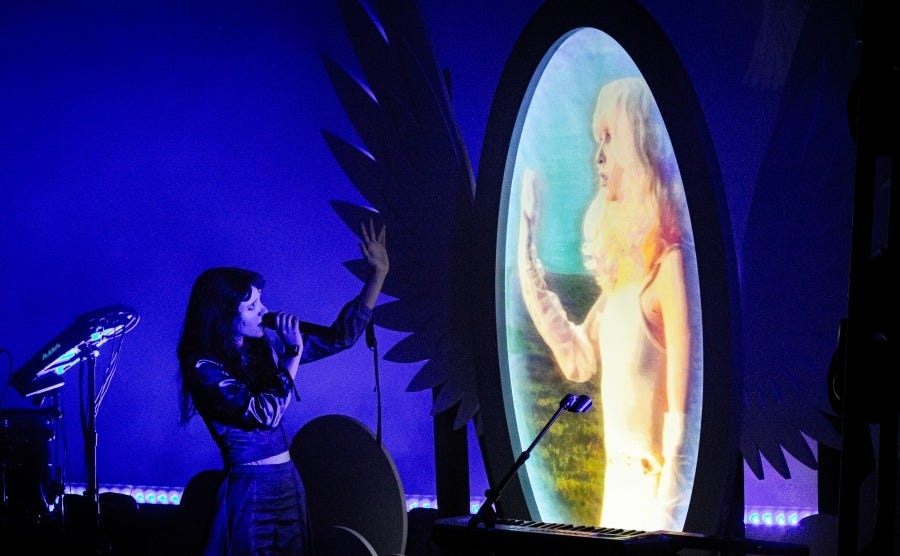
Yes I love Magdalena Bay. I saw them live on Friday and had a great time. So now you all have to hear about it.
The most important dynamic of 2026, as far as I can tell, is the backlash against artificial intelligence. AI is the topic that keeps on giving people something to talk about, and it’s a topic I’ve written about it a few times already by now: about its labor market impact, impact on gender, AI and cheating, its impact on loneliness, its impact on cities, and whether it’s a bubble, as well as a recent post about “AGI” and consciousness and how it relates to AI effecting the real world that I’m particularly proud of.
To add to the river of ink already spilled on the matter, Pope Leo XIV recently published his first encylical, Magnifica Humanitas (Latin for “Wonderful Humanity”), on the relationship between humanity and artificial intelligence. An encyclical is, more or less, a letter by the Pope address to the entire Catholic community on a matter of high importance. The Pope’s encyclical largely focused on two topics: AI and the “social question”, and AI and war. The latter is for another day, but the former is interesting enough on its own: the Pope’s take, unsurprisingly, is that human dignity and wellbeing has to take precedence over technological advancement, and that economic growth has to be paired with environmental preservation and social justice (understood as distributive justice). So far, so good.
Something that literally everyone noted is that the Pope signed the encyclical exactly 135 years after a different encyclical: Rerum Novarum (“Of New Things”) by Pope, you’ll be surprised here, Leo XIII. Rerum Novarum was largely about the social question, and established Catholic Social Teaching; it was also the Church’s first opinion on the Industrial Revolution, and that opinion was that worker’s rights were good and industrial capitalism crushing the spirits of millions was bad.
The Catholic Church declaring the Butlerian Crusade or whatever the Pope did caught me while reading a very weird book: Rudiger Safranski’s Romanticism: A German Affair, a book about, big shocker here, the history of the Romantic movement in Germany. It’s very good and I highly recommend it. I found it interesting because Safranski has a central idea he drags through 250 years of Romantic thought: Romanticism was, at its core, a reaction against Enlightenment rationalism and instead a preference for infinity, the organic, authenticity, and community. The book starts with the main predecessor of German Romanticism: Sturm und Drang, “Storm and Will”, a movement in the late 19th century that sought to confront a world in complete political upheaval from the French and American Revolutions. The two main figures are Johann von Herder and Johann von Goethe; both were, at first, idealistic optimists, but over time diverged. Herder was a liberal universalist: his story began traveling from Riga (then around the border between Sweden, Russia, and Prussia; now in Latvia) to Strasbourg to meet Goethe; during his trip he collected folk songs from the people he encountered. His main ideas were about language, history, and nation: language determined worldview because all worldview is done through language; history is about the interplay between worldviews and the objective world, and has a tendency to progress over time; and nations are comprised of only one people, rather than classes of people, and are united by language and tradition, which are the same thing. His latter two views led him to ardently support the French Revolution, a position that drove him apart from Goethe: the other German was skeptical of religion and nationalism, was not particularly attached to Christianity, and instead wanted to focus inward, on the self, and on nature.
The central tension between Goethe and Herder was the tension between the individual and the collective and between politics and contemplation; these distinctions would come to define the two centuries of Romantic thought. Romanticism, as Safranski notes in his introduction, has countless contradictions: with and over religion, in love with both the past and the future, with the ordinary and extraordinary, with dreams, madness, and introspection; it is both nostalgic and cynical; ironic and exalted; and self-involved and communitarian. The best definition of Romanticism, then, comes from poet Novalis (real name Georg von Herdenberg, other professions salt mine engineer):
The world must be romanticized. In this way its original meaning will be rediscovered. (…) Insofar as I give a higher meaning to what is commonplace, and a mysterious appearance to what is ordinary, the dignity of the unknown to what is known, a semblance of infinity to what is finite, I romanticize it.
Safranski aims at distinguishing between Romanticism as a precise literary movement, concentrated in the first two decades of the 19th century, and the “romantic spirit”; to do this, he mostly relies on four other thinkers: British political philosopher Isaiah Berlin, conservative American political philosopher Eric Voegelin, Hungarian Frankfurt School Marxist Gyorgy Lukacs, and a blog regular, the Nazi jurist Carl Schmitt. Berlin’s very famous 1965 book The Roots of Romanticism argues that the Romantic spirit constituted a profound shift in human consciouness centered on rejecting the Enlightenment view that there was only a singular, universal truth graspable through reason; the Romantics, in contrast, reveled in subjectivism and self expression, and focused on a heroic individual yearning for infinity. Voegelin’s critique is a lot less explicit: he believed currents like Romanticism were replacing God and Christianity with worshipping humanity itself by exalting individuality, subjective feeling, and artistry, which in turn was rooted in a profound alienation from the existing world and a desire to forcibly create a new, perfect reality. In contrast, Lukacs, befitting of a Marxist, gave a materialist critique in his 1945 essay Romanticism: he saw it as a burgeois movement of the intelligentsia that rebelled against the mass displacement of people during the transition to industrial capitalism. However, the Romantics were themselves burgeois, and their struggle was to turn all human endeavor into a subjective, artistic process - a process that was frequently used in service of the preservation of feudalism and reaction. Lukacs understood German Romanticism as a German response to the French Revolution - a response that sought to prevent such a Revolution from happening in Germany. Finally, Carl Schmitt’s lesser known 1919 book Political Romanticism was also a critique of Romanticism, one centered on its political dimension: because Romanticism treats the entire world as an aesthetic object and centers its emotional aspect, Schmitt believed it produced political passivity and an inability to act or decide politically. The Romantic is thus an “occasionalist”, someone who uses every event as an “occasion” for their own self-expression and aesthetic enjoyment.
The four are synthetized in Romanticism A German Affair: for Safranski, the movement was too complex to say it either promoted or didn’t promote revolution or reaction; but he, in large part, believes all four authors have something worth saying. For Safranski, Romanticism was a reaction to the Enlightenment, particularly to what Max Weber described as “disenchantment”: a world without magic, where everything is understood but nothing is valued. Weber was worried this would work as an “iron cage” (or a “cog in a machine”) where people know exactly what they’re doing but not why or what for; this should produce, in turn, problems legitimizing convictions that people hold anyways, which Weber compared to a polytheistic religion where all the gods are at war against each other - resulting in basically interminable paralysis when people want to take meaningful stances (“sensualists without heart” and “specialists without spirit”). Weber saw modernity as the process of rationalization, the replacement of all traditional and charismatic modes of life with calculation, efficiency, and universal rules grounded in logic; and the Romantics were standing athwart rationalization yelling STOP. Romanticism is always a reaction to modernity: Hegel and Marx were both influenced by the Romantic spirit and believers in technical and rational progress (for Marx, the development of the forces of production; for Hegel, the development of the rational spirit). However, both Schmitt and Lukacs fail to realize the potential of the Romantic spirit for action: extolling individuality, autonomy, and self expression also provided a boost for certain revolutionary spirits, particularly those of Richard Wagner (in his early days) and Friedrich Nietszche.
For Safranski, Romanticism emerged in a context in which people felt like their daily lives were completely administered and “known”, and where the broader world was completely impassive to their actions: the Age of Revolution came and went, and was followed by the Industrial Revolution (here’s where friend of the blog Karl Polanyi comes up). Raymond Williams’s 1958 book Culture and Society, 1780–1950 deals with this topic: for him, the idea of “culture” (as a whole way of life) emerged as a response to the Industrial Revolution and the inhuman forces it wrought upon the world; to Williams, industrialism displaced the way of living and being that people had taken part in for centuries in a way that prompted them to create a criticism of industrialization through humanistic ethics. In particular, he pinpoints the start of this tradition with the British Romantics, who (like their German brethren) saw culture as the spirit of the people in contrast to the product of machines - think of William Blake describing factories as “dark satanic mills” that reduced life to its mechanical components, as well as Wordsworth and Coleridge trying to rescue human feeling and the organic world from both factories and rationalization.
The relationship between Romanticism and politics was one of its most fraught components. As we’ve seen with Marx and Herder (as well as Heinrich Heine and Ludwig Feuerbach, among others) the onus placed on action, self expression, autonomy, and peoplehood was a source of emancipatory politics, particularly in the 19th century. However, the political ramifications of Romantic thought were largely, as Lukacs cautioned, reactionary: the latter Romantics, particularly after Nietszche and Wagner, grew increasingly antidemocratic, militaristic, and antisemitic, as part of their obsession with the organic nature of the nation, its religious and cultural unity, and their irrationalism. There is a spectre haunting German Romanticism, both because it’s German and especially because it’s Romantic: the spectre of Nazism. Hitler and Goebbels took an enormous amount of inspiration from Hoffman and especially Wagner, as well as Goete, Hölderlin, and even Heine; at the same time, they considered that Romanticism was too aesthetic and too introspective to be the basis for an Aryan superman. The rejection of rationality and universalism coupled with the absolute rationalization of life and the economy struck many people as contradictory; the same reasons that attracted Martin Heidegger to the Nazi Party (its focus on the nation and its people, its organicity, and its rejection of the instrumentalization of human life) are what the scholars of the Frankfurt School criticized of it. As I’ve noted in the past, Herbert Marcuse and Heidegger had the exact same criticism of technology as a system of social organization, and yet one was a Nazi and one was so opposed to the Reich he joined the OSS (predecessor of the CIA) to fight them.
This is what brings us to the present. I’ve noted, in the past, that Romanticism is the source of both wokeness and the reactionary spirit. Romanticism, with its emphasis on self-expression, authenticity, and self determination in the face of a hopeless and oppressive world, was a perfect conduit for the political current now known as Wokeness. The criticism that wokeness was “narcissistic” and about egotistical grievances (espoused by, say, Bari Weiss’s wife) is exactly the same as Carl Schmitt and Lukacs said about the Romantics. Woke essentialism is, like centrists try fruitlessly to claim, similar to groyper essentialism: not because one caused the other, but because both are Romantic; the Romanticism of national liberation was also the Romanticism of pastoral critics of urban modernity which, over time, led to it providing some of the central imagery of the early 20th century Völkisch movement. The Völkisch movement was crucial to establishing the Nazi Party. In Spain, both Federico Garcia Lorca and Rafael Sanchez Mazas were influenced by Romanticism - with traditional, medieval, and Catholic themes being valorized in their highly emotional work. However, that was where the similarities end: Garcia Lorca was executed by a Francoist firing squad for being gay, republican, and vaguely anticapitalist, while Sanchez Mazas defined himself as “the first fascist in Spain” to a trio of small-town goat herders to secure food and shelter while fleeing his own botched execution by his republican captors.
There’s two reasons to dredge up Romanticism at this time. The first is to ascertain the discussion over fascism: if at least some of contemporary right wing political action is fascism (and I believe it is), then they could have similar origins and intellectual trajectories, and be responding to similar social maladies. The other is that people are, increasingly, discussing it: fellow Substack blogger Ted Gioia wrote about Romanticism as a factor emerging from AI in 2023 (very prescient); author Ross Barkan wrote about it for The Guardian in late 2023 and at further length in 2025 on his Substack; economist Martha Gimbel wrote about Dickens and Elizabeth Gaskell on Bloomberg. The common thread here is that we live in a time of unprecedented political upheaval, enormous economic transformations, and also a drastic shift towards rationalization of life: what would any of the men I’ve mentioned think of tech entrepreneur Garry Tan saying people are ready to worship AGI as their God?
The backlash against AI is real and serious, as well as central to politics in the next decade. People don’t just see their livelihoods threatened - they see their whole way of life under serious assault, with people like Sam Altman proposing selling them our intelligence and renting it back on a meter. I’ve written pretty extensively about Guillermo del Toro’s Frankenstein as being mainly about artificial intelligence; it should be noted that the book was written in 1818, right in the zenith of the First Industrial Revolution, but also at the time of another earthquake for human self-understanding: per philosopher Thomas Moynihan’s X-Risk, (a book about the history of the Apocalypse in human thinking),the book came right around the time of two major humblers of the human race: Georges Cuvier’s discovery of past mass extinction events, and Pierre de Maupertuis and Georges Buffon’s theory of the evolution of species, which focused on “superior” creatures displacing “inferior” ones. This pointed to something seemingly inevitable: that humans could be replaced by creatures we create. In Frankenstein, the monster isn’t considered a corpse or a deformed human - he’s considered a different species, and Victor Frankenstein’s refusal to create him a bride comes from a reluctance to populate Earth with a “race of demons” who will kill and replace humans.
The other thing I think sets German Romanticism apart is its emphasis on loneliness and social alienation. In Madame de Stael’s Allemagne, Safranski notes, she points out that the Germans live too far apart and in too small towns to have real social and community institutions. The lack of urban centers and the small scale of social life meant that Germany wasn’t made up of a single political community, but rather of countless small autocracies containing little private worlds, which could, yes, produce great individual characters, but not a mass movement. Without a more community-focused political culture, Safranski notes, the political imagination would develop exclusively around the individual and its sublime, idyllic, radical, or secretive beliefs. It is also worth highlighting the fascination that the Romantics had with secret societies, secret cabals, and secret clubs: Goethe was a member of the Illuminati, multiple of his disciples were freemasons, and secret societies and their machinations play major roles in Goethe’s Wilhelm Meister as well as Jean Paul’s Titan, Achim von Arnim’s The Crown Guardians, and Ludwig Tieck’s William Lovell. Of course, both of these are major, central factors of modern political life: conspiracy theories, and loneliness and social alienation.
So we have a full bingo: major political upheaval and transformation, mass economic precarity and looming displacement, a cult of reason threatening to tear up the entire world for the sake of technical progress, loneliness and alienation, conspiracy theories, an obsession with the “organic” and the “natural”. In a world in which people are increasingly measuring their every waking moment, comparing themselves to flimsy “objective” targets, and just all around controlling and optimizing every second of their existence, something has got to give. Where we’re going, everything is romantic.
Postscript: to quote the song that gives this post its title, I will be “on a hotel bed / hungover on Tokyo time” soon, because I’m leaving for a trip to Japan for a few weeks. So take that as a vacation.
Enjoy Japan! I had a great time last year https://cathyreisenwitz.substack.com/p/exploring-gender-in-tokyo?utm_source=publication-search
https://cathyreisenwitz.substack.com/p/tokyo-taught-me-to-have-fun?utm_source=publication-search
There is some pretty good reasoning in Matthew Bells new book on Goethe that he joined these group to keep an eye on some the more radical members as some of the students were sympathetic to Revolution etc